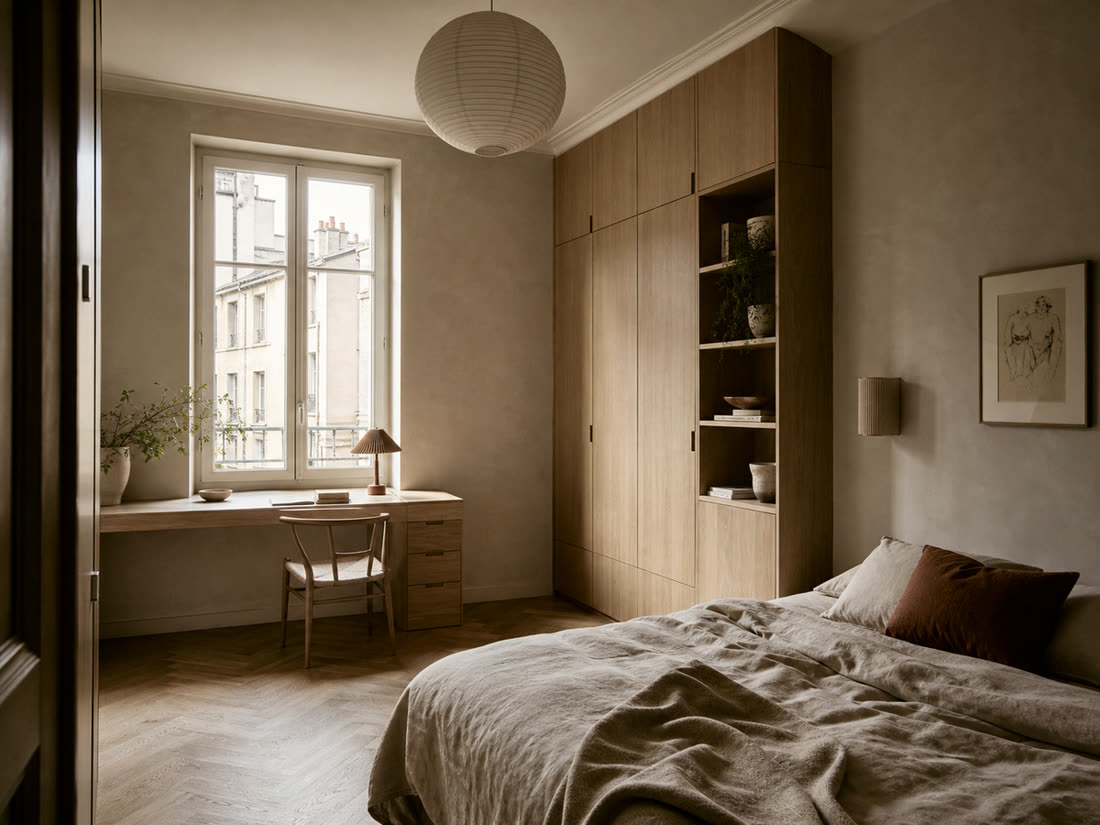
The apartment on Rue Burdeau has the standard Croix-Rousse inheritance: four metres under the beams, windows sized for looms, and a ceiling crack the owner had been watching for two winters. We opened the cornice expecting lath and dust.
Instead: a shelf. A full-depth timber shelf running the length of the room, built above a false cornice line, invisible from below. The silk weavers who worked these rooms stored a winter’s worth of bolts up there — dry, dark, and completely out of the working volume. It had survived one hundred and eighteen years and two renovations that never noticed it.
The trick, measured.
The false cornice sits at 3.1 metres. Above it: 82 centimetres of clear height to the beams, the depth of the room’s short wall, and a hinged hatch board that a person on a ladder can work through. Roughly 2.4 cubic metres of storage, which is more than the fitted wardrobe we had drawn for the entry hall — the wardrobe that was going to cost the hall forty centimetres of width.
We redrew the plan that evening. The hall keeps its width, the ceiling keeps its line, and the crack turned out to be the hatch board settling, not the structure.